
In this sheet
Does your preteen seem to think other people’s opinions matter more than yours?
Is their behaviour changing?
Are they pushing back against rules that they never questioned before?
Are you worried your relationship is suffering?
This fact sheet contains answers and ideas.
The preteen years: different needs
As your child enters the preteen years, they may start to develop new behaviours such as:
- Testing house rules and your limits;
- Having mood swings (for example, being more irritable);
- Being influenced: by friends, family, teachers, social media, etc.;
- Boldly expressing their opinions, some of which can be unsettling.
Why are they doing this?
During the preteen years, children develop new needs:
- They want to make more decisions.
- They want to do things their own way;
- Friends are starting to become more important;
- They care more about what others think of them;
- Their bodies are changing.
- They start comparing themselves to others.
- They start searching for their identity.
Your challenges?
- Adapting to your child’s new needs;
- Being open to their arguments, which may be valid even if you hadn’t considered them before;
- Maintaining a positive relationship despite arguments or disagreements;
- Providing guidance while giving them room to grow.
Preteens’ choices are often based on immediate gratification and wanting to feel accepted.
They don’t always think about the consequences of their choices. Your presence in their life is essential!
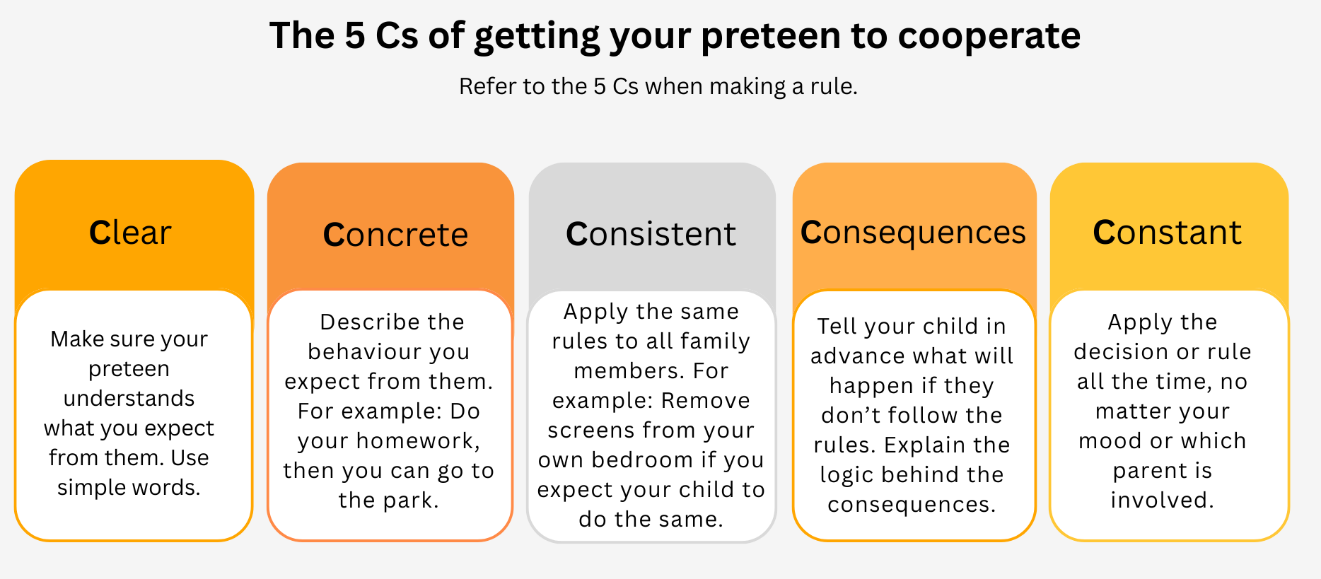
Guidance: still important to preteens
Practical resources and tools
1. For support :
You are dealing with a situation that worries you? Ask for help :
Community organizations: family centre, youth centre, etc.
Some community organizations offer support programs for parents of teenagers. Call your local organization for information.
School staff members
2. References
- CIUSSS de la Capitale-Nationale. (s.d.). Établir des règles efficaces. Programme Triple P.
https://www.ciusss-capitalenationale.gouv.qc.ca/triplep/conseils/generaux/regles - CIUSSS de l’Estrie – CHUS. (s.d.). Circuit parents 5–11 ans – Thème 4 : L’encadrement parental.
https://www.santeestrie.qc.ca/soins-services/theme/famille-parents-et-enfants/ressources-pour-les-familles/circuit-5-11-ans/theme-4 - Maman pour la vie. (s.d.). La discipline, c’est plus que des punitions.
https://www.mamanpourlavie.com/sante/enfant/developpement/comportement-et-discipline/6013-la-discipline-c-est-plus-que-des-punitions.thtm - Naître et grandir. (s.d.). Discipline : quand et comment définir des règles.
https://naitreetgrandir.com/fr/etape/1_3_ans/comportement/ik-naitre-grandir-enfant-discipline-definir-limite/
Last updated
: