
In this info sheet
Feeling stressed is normal. Stress is even useful and necessary.
Stress often causes uncomfortable sensations, which is why so many people are afraid of it. But there are ways your teen can manage stress.
But what about anxiety? What’s the difference between stress and anxiety? How can you tell if your teen has anxiety? When should you ask for help?
Read on for the answers to these questions!
Understanding stress
Your teen may be stressed without you even realizing it.
Stress is a normal and temporary reaction.
Your teen may be stressed by a situation that seems normal or even trivial to other teenagers. For example:
- A test at school;
- A sports meet;
- An argument at home or at school;
- A breakup;
- A new job;
- Exploring their sexual orientation or gender identity.
When stress triggers an alarm signal in your teenager, it may cause discomfort:
Physical reactions:
Psychological reactions
On the other hand, a healthy dose of stress can have positive effects.
Identifying and reducing the causes of stress
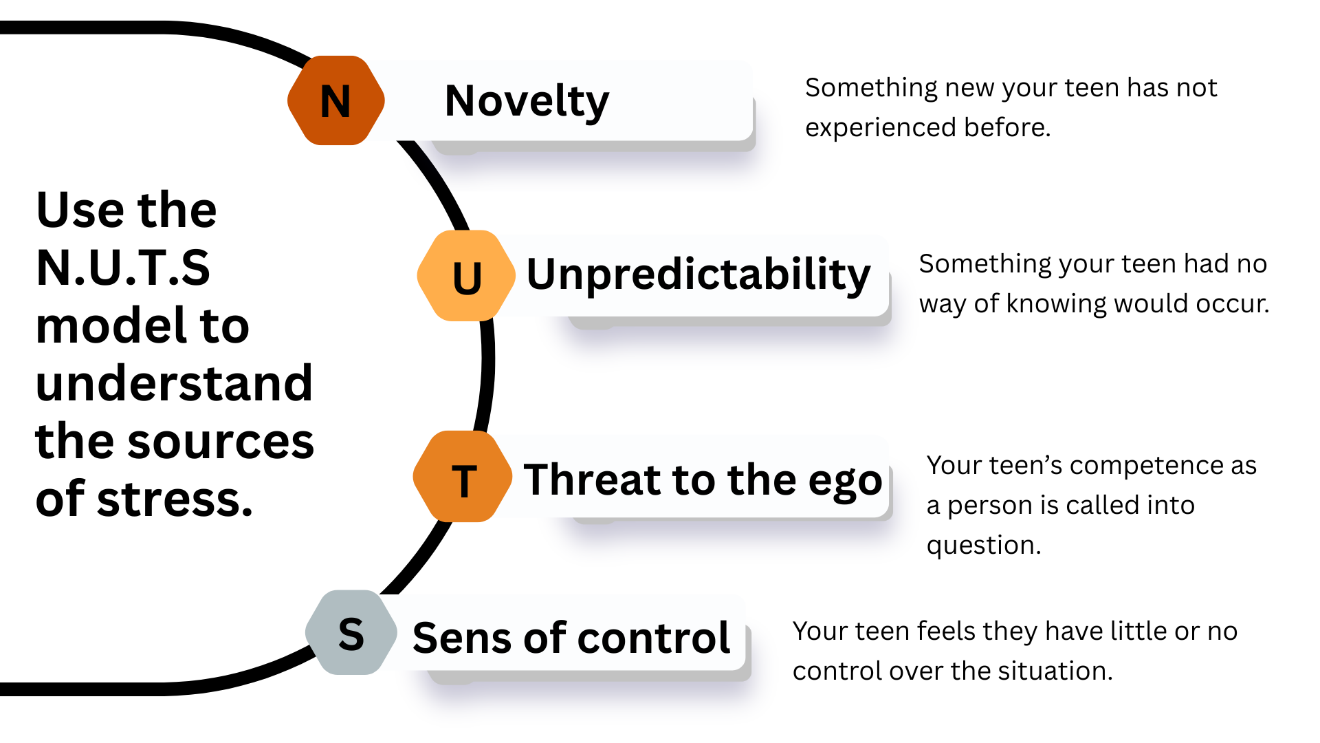
Once the causes of stress have been identified, your teen can start reducing them with questions such as:
- How can I have more control over the situation?
- How can I make the situation a little more predictable?
- Have I ever experienced another situation like the one that’s causing me stress? If so, what strategies did I use to cope with it?
- How can I feel more in control if I fail? Could I try again?
For example, before a test, your teen could use the following strategies like:
- Study to feel more in control;
- Ask the teacher what important points to focus on. Your teen will be better prepared, and the test will be more predictable.
To learn more about coping with stress, visit Stress N’ Go by the Centre for Studies on Human Stress (CSHS).
What about anxiety?
Anxiety is thinking about a catastrophic situation that isn’t happening and might never happen.
It’s the fear of a danger that doesn’t exist.
Anxiety is the fear of fear itself!
And just like stress, it causes a whole range of unpleasant sensations.
Fact
(Quebec Health Survey of High School Students, 2022-2023):
35% of high school students have anxiety.
If your teen has anxiety, they can choose to:
When to worry about your teenager?
Ask yourself these questions:
- Has your teen been anxious for a while now?
- Is your teen experiencing distress?
- Does anxiety prevent them from doing their daily activities, like seeing friends or going to school?
If you answered yes to one or more of these questions, encourage your teen to speak to a health professional.
Want to learn more about stress and anxiety? Visit the HORS PISTE site.
Be there for your teen
Practical resources and tools
1. For support :
Si vous vivez une situation qui vous préoccupe, il ne faut pas hésiter à en parler ou à consulter un∙e intervenant∙e ou un∙e professionnel∙le de la santé et des services sociaux :
Community organizations: family centre, youth centre, etc.
Some community organizations offer support programs for parents of teenagers. Call your local organization for information
School staff members
2. Learn more :
- Mini-guide anxiété des ados spécial familles
- Fondation Jeunes en Tête
- Hors-Piste
- Tel-jeunes
- Time out pour l’ado stressé
- Surfe ton stress
3. References :
- [i] Centre d’étude sur le stress humain, 2009 et Lupien, 2010, cités dans Le réseau québécois de l’Association canadienne pour la santé mentale. (s.d.). Pour faire baisser la pression, arrête-toi et spin ton stress!
- [ii] Benado. (s. d.). Stress et anxiété. https://parents.benado.org/stress-et-anxiete
This info sheet has been written in collaboration with :
Émilie St-Onge, agente de planification, programmation et recherche, Programme national de prévention des troubles anxieux HORS-PISTE, CISSS de la Montérégie-Centre
Roxanne Brosseau, co-directrice de Benado
Last updated
: